What Does the Current Fairfax County Real Estate Market Mean for Sellers? | Mid-June 2026
- Scott Ford

- Jun 11
- 3 min read
The latest Fairfax County and Northern Virginia real estate market data in June 2026 continue to reveal an increasingly segmented market.
Buyer demand remains healthy, but Buyers continue to focus on newly listed Houses while extended-market inventory continues to expand.
What Is the Most Important Signal in the Current Fairfax County Real Estate Market in June 2026?
The strongest market signal this week is the widening difference between where inventory is accumulating and where Buyers are actually purchasing Houses.

In Fairfax County, 43% of Active Houses have now been on the market more than 30 days, yet only 17% of Houses going Under Contract during the May 27–June 9 period were 30+ day listings.
This imbalance suggests that the extended-market inventory segment is growing faster than Buyers are absorbing it.
Is Buyer Demand Still Concentrated During the First Two Weeks?
The broader Northern Virginia market continues to show that Buyer attention remains heavily focused on newly listed inventory.
Only 35% of Active Houses are within their first 14 days on market, yet 67% of recent New Contracts occurred during that same initial listing period.
The first two weeks after launch continue to represent the period of greatest Buyer engagement.
What Happens When a House Misses That Initial Window?
Current Fairfax County data shows:
57% of Active Houses have been on the market more than 21 days.
43% have exceeded 30 days on market.
Houses beyond 21 days average approximately two months on market.
Houses beyond 30 days are approaching three months of average market exposure.

The broader Northern Virginia market segment is also showing that extended days on market Houses are making up a larger part of the Active House inventory, with 44% of Active Houses at 30+ days on market and now 20% at 60+ days on market. These houses have an average of nearly 3 and 4 months average time on market.
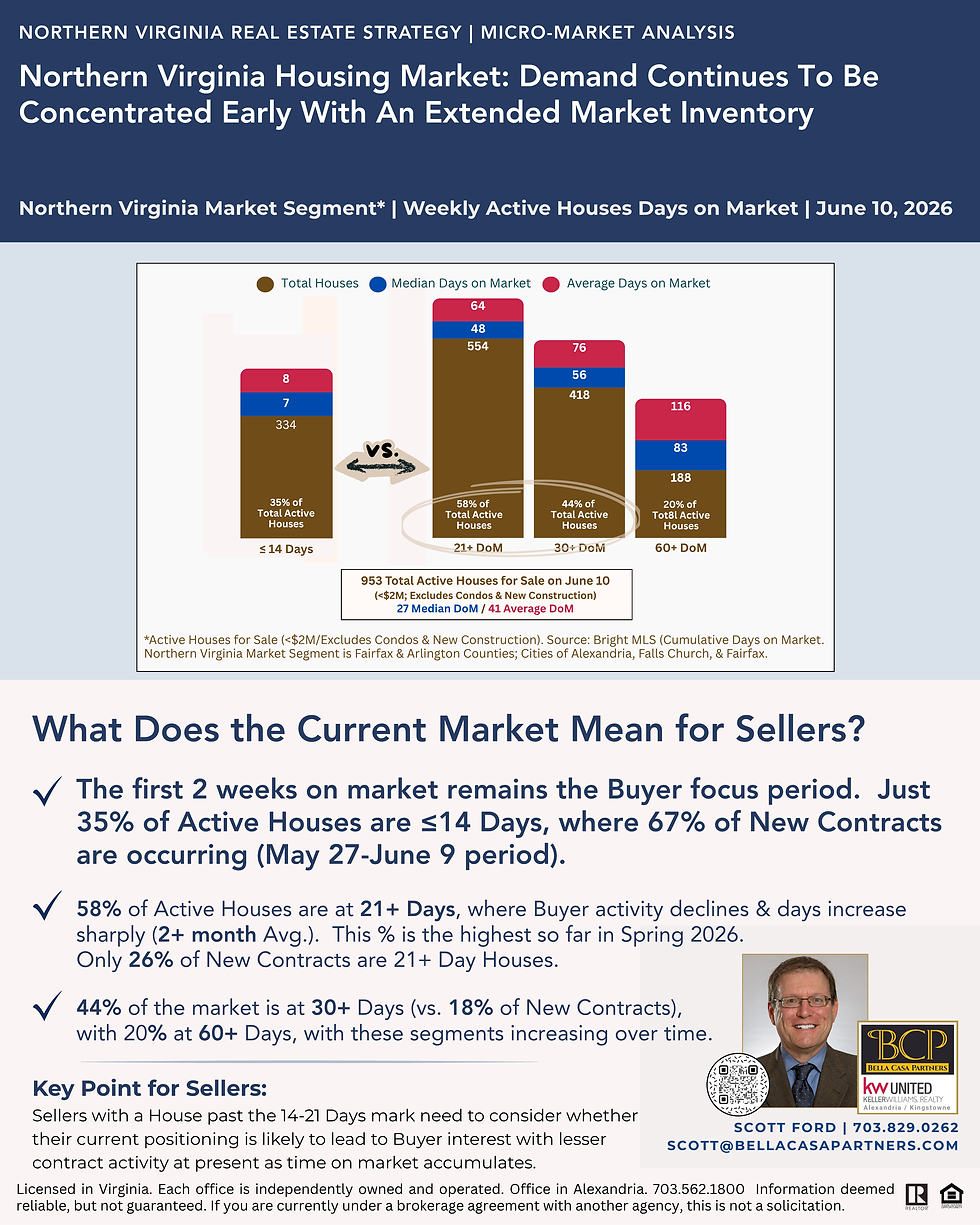
As inventory accumulates, Buyers have more choices and become increasingly selective.
Is the 14–21 Day Period Becoming the Market's Tipping Point?
The latest Fairfax County and Northern Virginia market data suggest that the 14-21 period after listing is becoming an increasingly important transition point in today's housing market.
Buyer activity remains heavily concentrated during the first two weeks after a House reaches the market, yet the percentage of Active Houses remaining beyond 21 days continues to grow.
Once a listing moves beyond that initial period of Buyer attention, it increasingly competes against a growing supply of extended-market inventory where Buyer activity is substantially lower.
The data does not suggest that Houses cannot sell after three weeks. Rather, it indicates that the probability of attracting strong Buyer interest declines as market exposure lengthens and Buyers gain additional competing options.
For Sellers, maximizing Buyer interest before a House reaches this apparent tipping point may become one of the most important factors influencing both time on market and overall sale outcome.
What Does This Mean for Sellers?
The current market is not characterized by weak demand.
Rather, it is becoming increasingly segmented between newly listed inventory attracting Buyer attention and extended-market inventory that competes for a smaller share of Buyer activity.
The objective for Sellers should be to maximize Buyer engagement during the first two weeks after launch through strategic pricing, thoughtful preparation, exceptional presentation, and disciplined marketing execution.
Key Takeaway
The current Fairfax County and Northern Virginia housing markets continue to demonstrate that Buyer demand remains strongest for newly listed inventory while the extended-market inventory segment continues to expand.
The latest market data suggest that the period between approximately 14 and 21 days on market is emerging as an increasingly important tipping point.
Houses that generate strong Buyer interest before reaching that threshold appear significantly better positioned than those entering the expanding extended-market inventory, where Buyer activity becomes materially less concentrated.



Comments