Where Fairfax County's Future Housing Growth Will Occur | Long Term Housing Trends Series No. 3

Where new housing is built matters just as much as how much housing is built.
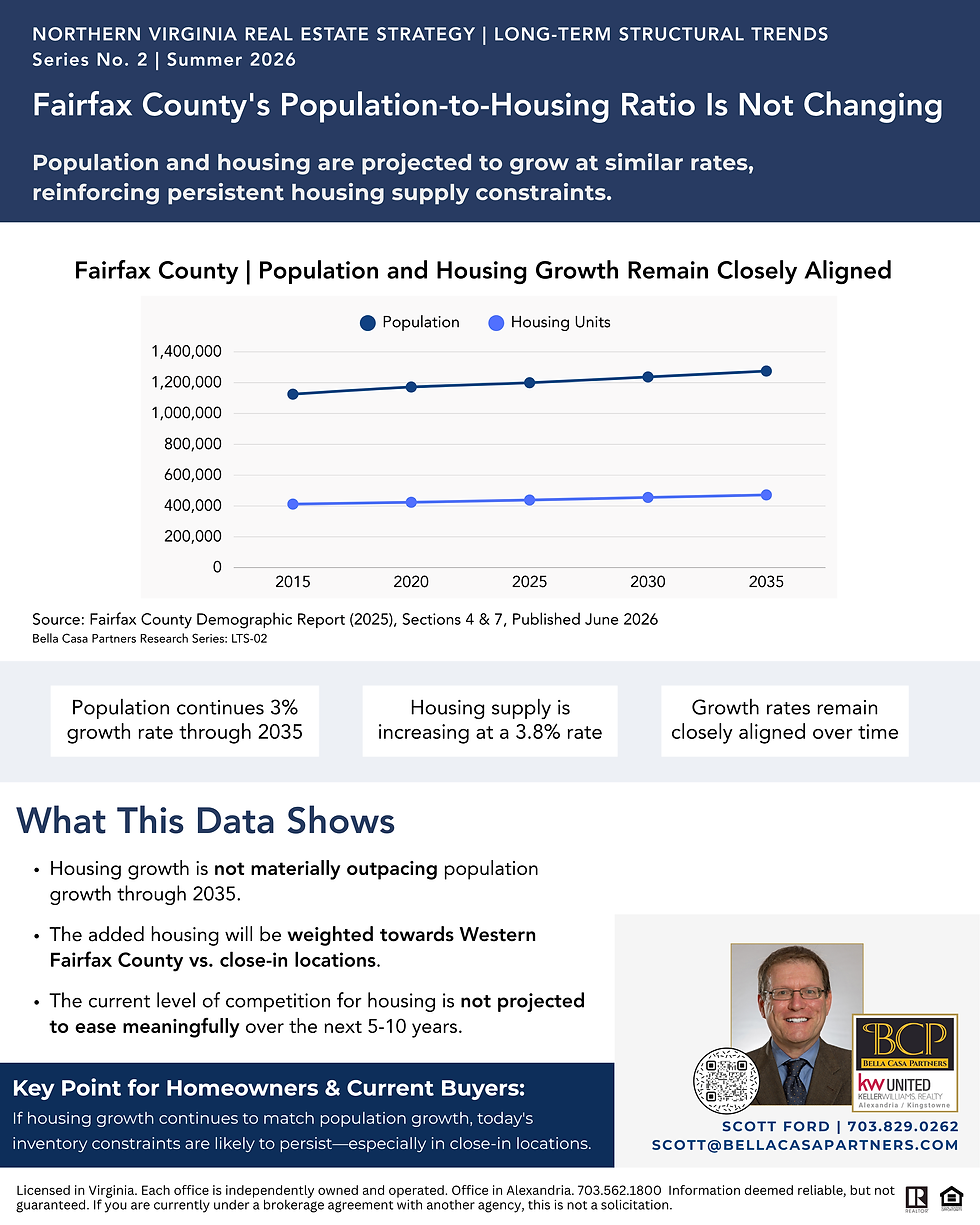
Long Term Housing Trends Series No. 2 examined why Fairfax County's population and housing growth are expected to remain closely aligned through 2035, suggesting today's inventory constraints are unlikely to ease meaningfully over the next decade.
This report builds on that analysis by examining where Fairfax County future housing growth is projected to occur. The 2025 Fairfax County Demographic Report (published in June 2026) shows that most new housing will be concentrated in a relatively small number of redevelopment areas—and that the overwhelming majority of those new housing units will be multifamily rather than detached houses or townhouses.

What the Fairfax County Future Housing Growth Data Shows
The County projects approximately 34,000 new housing units will be added between 2025 and 2035.
Three findings stand out.
Approximately 80% of projected new housing units are expected to be multifamily housing.
Approximately 70% of all projected housing growth is concentrated within the Upper Potomac, McLean, and Vienna Planning Districts, largely encompassing the Tysons–Reston–Herndon redevelopment corridor.
Just 10 ZIP Codes account for approximately 72% of all projected housing growth throughout Fairfax County. Just 2 of these 10 ZIP codes are outside the Planning Districts referenced in the 2nd bullet (Merrifield & Springfield/Newington), with these ZIP codes occupying the last two positions on the top 10 list.
Rather than being distributed evenly across the County, future housing growth is expected to be concentrated within established redevelopment corridors where existing transportation infrastructure, employment centers, and mixed-use development already exist.
Why Housing Location Matters
Housing projections are often viewed simply as a measure of supply.
Equally important, however, is where that supply is being added.
Most established neighborhoods inside or near the Beltway are projected to experience little (or no) new residential construction compared to western Fairfax County's redevelopment corridor.
For homeowners, this suggests that many established neighborhoods are unlikely to experience substantial increases in competing housing inventory over the next decade.
For Buyers, it reinforces that housing opportunities are expected to remain concentrated in specific redevelopment areas rather than broadly distributed across Fairfax County.
Housing Growth Does Not Mean Every Community Will See More Inventory
One of the most common misconceptions is that countywide housing growth automatically results in more inventory throughout every neighborhood.
The demographic projections suggest otherwise.
Although Fairfax County is expected to add more than 34,000 housing units through 2035, much of that growth is concentrated geographically and primarily consists of multifamily housing.
Communities outside these redevelopment corridors may therefore experience relatively little direct impact from new construction.
This distinction becomes important when evaluating long-term housing availability, neighborhood competition, and future Buyer choices.
Looking Ahead
This report is the third installment in the Bella Casa Partners Long Term Housing Trends series.
Earlier reports examined:
LTHT-01 | Fairfax County's Long-Term Housing Supply Gap (link): Why Fairfax County continues to face a long-term housing supply challenge.
LTHT-02 | Fairfax County's Population-to-Housing Ratio Is Not Changing (link): Why projected population growth and housing growth remain closely aligned through 2035.
The next report will examine a related question:
Does adding more housing automatically create more Buyer choice—or does the type of housing being built matter just as much as the total number of new housing units?
Continue the Long Term Housing Trends Series
This article is part of the Bella Casa Partners Long Term Housing Trends research series examining the long-term forces shaping the Northern Virginia housing market.
Series No. 1: Fairfax County's Long-Term Housing Supply Gap (link)
Series No. 2: Fairfax County's Population-to-Housing Ratio Is Not Changing (link)
Series No. 3: Where Fairfax County's Future Housing Will Be Built (current article)
Series No. 4: More New Housing Does Not Always Mean More Buyer Choice (coming on July 22)
Frequently Asked Questions
Why is most future housing projected to be located in the Tysons–Reston–Herndon corridor?
These areas already contain major employment centers, planned redevelopment districts, Metrorail access, and infrastructure capable of supporting higher-density development. County planning policies have concentrated much of Fairfax County's future residential growth within these established redevelopment corridors.
Does this mean every Fairfax County neighborhood will see significant new construction?
No. The demographic projections indicate that future housing growth will be concentrated within a small number of planning districts and ZIP Codes. Most established neighborhoods are expected to experience comparatively little new residential development through 2035.
Why is multifamily housing expected to account for most new construction?
Higher-density development allows additional housing units to be added where land is limited and infrastructure already exists. Fairfax County's projections anticipate that approximately 80% of new housing units added through 2035 will be multifamily housing.
How does this affect homeowners?
For many established neighborhoods, limited new competing inventory may help preserve the current balance between housing supply and demand. Market conditions will still vary by community, but future housing growth is not expected to be evenly distributed throughout Fairfax County.
How does this relate to the previous Long Term Housing Trends reports?
This report builds directly on earlier research showing that overall housing growth is expected to remain closely aligned with projected population growth. Together, the reports explain both how much housing Fairfax County expects to add and where that housing is projected to be built.

Comments