Fairfax County Buyer Activity Is Reaching Further Into Longer Days on Market Inventory, Even as Days on Market Remain at 2025 High Point | Northern Virginia Housing Market Update | August 27, 2026

Updated: Sep 3
Northern Virginia enters the final weekend of August with two market conditions occurring at the same time.
First, extended Days on Market inventory remains near its highest level of 2026. More than half of Active Houses in both Fairfax County and the broader Northern Virginia market segment at least 30 days on market
Second, Buyers have recently begun directing a substantially greater share of New Contract activity toward those longer Days on Market Houses.
That combination is important.
The market has not suddenly shifted to favoring older listings. Recently listed Houses continue to receive a disproportionate share of Buyer activity. But the gap between recently listed Houses and 30+ Days on Market Houses going Under Contract has narrowed substantially over the last 4-6 weeks.
The data at the end of August also add another dimension to this analysis: the Houses that Buyers are selecting are taking longer, on average, go Under Contract.
Together, these measures provide a more complete picture of how Buyer behavior has changed as Northern Virginia enters the Fall market.
Buyer Activity Is Reaching Further Into Existing Inventory

The Fairfax County Buyer Activity Ratio compares two segments of the market:
Houses going Under Contract within their first 14 days; and
Houses going Under Contract after 30+ Days on Market.
For August 12–25, 45% of Fairfax County New Contracts involved Houses with 14 days or less on market, while 34% involved Houses with 30+ Days on Market.
That produces a 1.3-to-1 Buyer Activity Ratio favoring recently listed Houses.
The significance is not simply the current ratio. It is how much that relationship has changed.
In mid-July, Houses with 30+ Days on Market represented only 17% of weekly New Contracts. During each of the most recent three weeks, approximately one-third of New Contracts involved 30+ Day Houses.
Buyer attention has therefore expanded considerably further into the longer Days on Market inventory.
That does not mean Buyers now prefer longer Days on Market Houses. Only about one-quarter of Fairfax County Active Houses are within their first 14 days, yet this relatively small inventory segment generated 45% of recent New Contracts.
Fresh inventory still commands disproportionate Buyer attention.
What has changed is the degree of that advantage.
All data in this post relates to Houses ≤$2M; excluding Condos and New Construction, unless otherwise stated.
Extended Days on Market Inventory Remains at Its 2026 High
The shift in Buyer activity has not yet materially reduced the accumulated longer-market inventory.

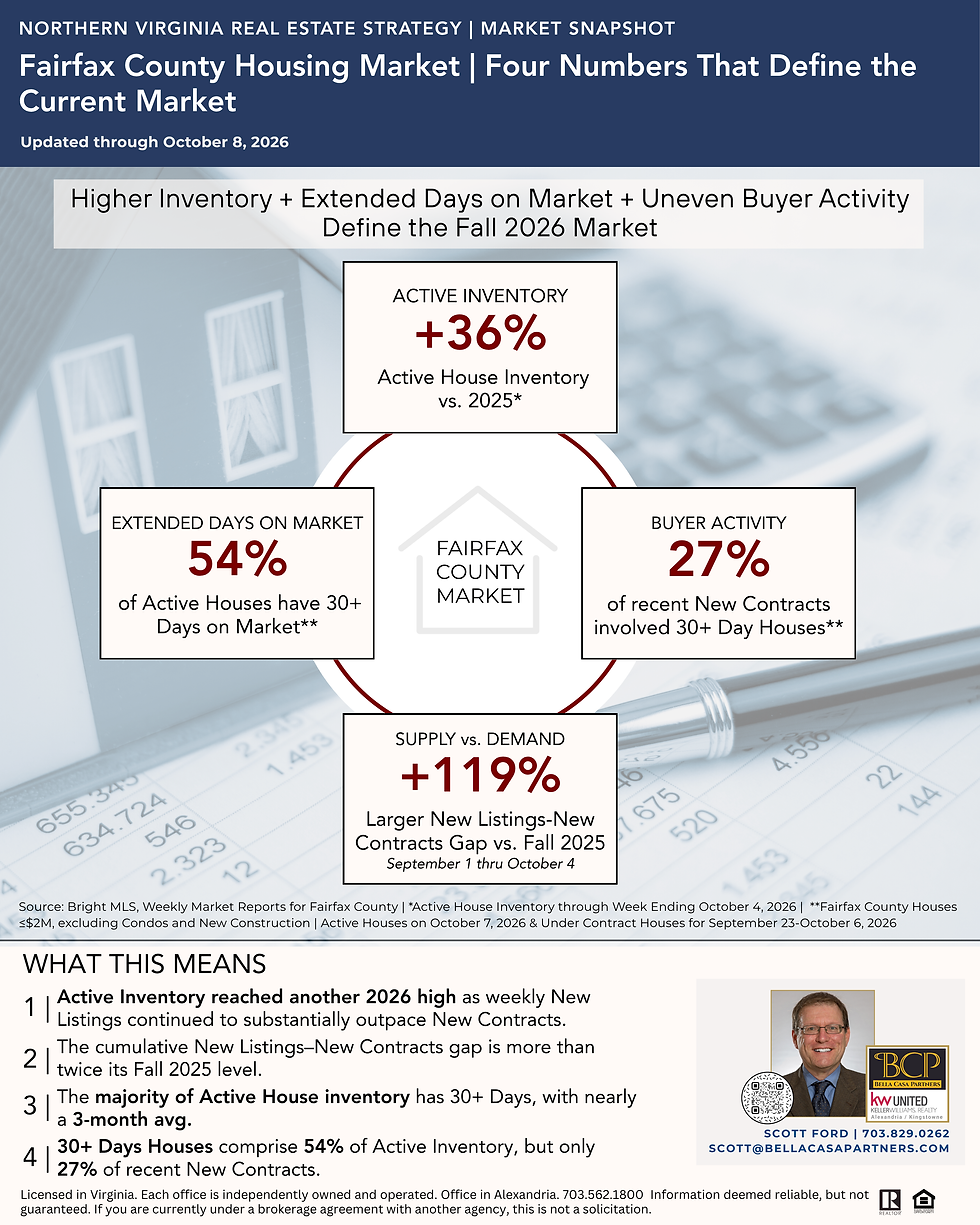
As of August 26, Fairfax County had 893 Active Houses under $2 million, excluding Condos and New Construction.
Of these Active Houses:
68% had 21+ Days on Market, with a 2+ month average time on market;
56% had 30+ Days, with nearly a 3 month average; and
30% had 60+ Days, with nearly a 4 month average.
These numbers remain at a high point for this year.
An increased probability that Buyers will consider older inventory does not mean accumulated inventory in this segment will decrease, absent a total level of New Contract activity that outpaces the number of Houses that enter these extended time on market segments.
The market spent months building this inventory. Even with greater Buyer activity reaching into the 30+ Day segment, more than half of the available Fairfax County Houses remain there.
The Same Pattern Extends Across Northern Virginia
Fairfax County is not an isolated example.

Across the Northern Virginia market segment, there were 1,108 Active Houses as of August 26.
68% had 21+ Days on Market, with a 2+ month average time on market;
57% had 30+ Days, with nearly a 3 month average; and
32% had 60+ Days, with nearly a 4 month average.
The similarity between the Fairfax County and Northern Virginia distributions reinforces an important point: extended market exposure is a broader market condition, not simply a Fairfax County anomaly.
How Long Are Fairfax County Houses Taking to Go Under Contract?
The updated Fairfax County Under Contract Days on Market tracking provides another way to examine the change in Buyer behavior.

This analysis uses the same House category as the Buyer Activity Ratio and weekly Active House Days on Market analysis: Houses under $2 million, excluding Condos and New Construction.
That makes the measures directly comparable.
For each weekly period, the chart tracks:
Median Days on Market;
Average Days on Market; and
Average Days on Market for the 50% of Under Contract Houses above the weekly median.
The longer-term progression is more important than any single week.
During much of March and April, the upper half of Houses going Under Contract generally averaged only the low-to-upper 20s in Days on Market.
By June, that measure had moved into the 30-Day range.
During July, this category of Under Contract Houses waited in the upper 30-Day range.
During July and August, it moved materially higher, reaching 48, 50 and 54 Days during three consecutive August reporting periods before declining to 48 days during August 20–26.
The overall weekly average has also moved higher. It was generally in the low-to-mid teens during spring before reaching the 20s during July and August.
Why the Under Contract Days on Market Trend Matters
The unusually high August numbers deserve some caution.
Late-Summer New Listing activity has declined, the total number of weekly New Contracts has fallen, and a greater percentage of those Contracts has involved Houses with longer Days on Market. Each factor can influence the weekly DoM numbers for Under Contract Houses.
But the underlying trend predates the most pronounced August readings.
Even if September activity moves back toward the conditions seen during May and June - which may be the best case scenario for the Fall market - the data suggest that a substantial portion of Houses going Under Contract may still require approximately a month—or longer—of market exposure before receiving a Contract.
Does The 2-3 Week Market Tipping Point Still Matter?
Greater Buyer attention to older inventory does not eliminate the importance of early market exposure.
The first 2–3 weeks remain the Market Tipping Point because recently listed Houses continue to capture substantially more Buyer activity relative to their share of available inventory. Further, this recent shift in Buyer activity may not continue in early September when the expected increase in New Listings occurs as some Sellers wait until after Labor Day to list their House for sale.
What happens after this tipping point, however, is becoming more nuanced.
Earlier this year, remaining Active beyond the initial market window increasingly meant competing within a growing pool of Houses receiving relatively little Buyer activity.
The August data suggest Buyers are now looking more deeply into that pool.
For Sellers already beyond the Market Tipping Point, that is constructive. But the extended-market inventory remains a majority of the Active House inventory, and those Houses are competing against hundreds of other listings that Buyers can evaluate.
More Buyer attention towards longer Days on Market Houses does not eliminate the need to become the preferred choice within that larger competitive set.
What Should Sellers Watch in September for the Northern Virginia Market?
The first two weeks after Labor Day should provide particularly useful information.
Late summer normally brings fewer New Listings. If more Sellers enter the market in September, Buyers should have a larger supply of newly listed Houses from which to choose.
That creates an important test.
Will Buyers continue directing approximately one-third of their Contract activity toward 30+ Days on Market Houses when fresh inventory increases—or will Buyer attention shift back toward recently listed Houses?
There is also a second question.
Fairfax County has experienced 26 consecutive weeks in which New Listings exceeded New Contracts. If Buyer activity increases enough for New Contracts to begin consistently absorbing Houses faster than new supply enters the market, accumulated inventory could begin declining.
However, if New Contracts continue to lag New Listings, the current elevated inventory level could persist or face renewed upward pressure.
Those two September measures—where Buyers direct their attention and whether overall Contract activity can absorb incoming supply—should tell us considerably more about the direction of the fall market.
What Does the Current Market Mean for Sellers?
The late-August data do not support a simple conclusion that Houses either need to sell immediately or will not sell.
Instead, they show a market in which:
the first two weeks after listsing continues to provide the strongest opportunity to capture concentrated Buyer attention;
Buyers are increasingly considering Houses that have accumulated long Days on Market;
Houses are taking longer to reach Contract, which means some Houses that are high quality, presented well, and priced within an appropriate range are sitting on market due to a longer Buyer decision process in the current market environment; and
Sellers who remain Active face substantially more competition than they did earlier in the year or the same time last year.
That environment makes micro-market analysis particularly important.
Countywide and Northern Virginia data establish the market environment. A Seller's actual strategy must then account for the House's specific competitive set, pricing, condition, presentation, and how Buyers are responding to comparable alternatives.
Related Reading
Mid-August 2026 Northern Virginia Real Estate Market Update
For a broader analysis of the market trends behind the current inventory environment, read the Mid-August Market Update, which examines Buyer activity, rising inventory, Days on Market, and the latest Fairfax County and Northern Virginia market indicators.
Fairfax County Inventory Tracker: Active House Inventory Remains at a 2025 High Point, as Weekly New Contracts are at a Six Month Low | August 25, 2026
Buyer behavior is only one part of the current market. The latest Fairfax County Inventory Tracker examines the supply side of the market, including elevated Active House inventory and the continuing relationship between weekly New Listings and New Contracts.
Frequently Asked Questions
Are Buyers in Fairfax County paying more attention to Houses with longer Days on Market?
Yes. Houses with 30+ Days on Market accounted for approximately one-third of Fairfax County New Contracts during each of the most recent three weeks, compared with 17% during July 8–14. However, recently listed Houses still receive a disproportionately large share of Buyer activity relative to their share of Active Inventory.
Does increased Buyer activity for 30+ Day Houses mean Buyers now prefer older listings?
No. Houses with 14 days or less on market represented only one-quarter of Active Inventory but accounted for 45% of New Contracts during the August 12–25 reporting period. The recent change is that the advantage enjoyed by recently listed Houses has narrowed as Buyers give more attention to the accumulated longer Days on Market House inventory. The current ratio is 1-to-1.3 when comparing Under Contract Houses with ≤14 Days vs. 30+ Days, which is down from 2-, 3-, and 4-to-1 ratios seen in late Spring through mid-July.
Are Houses that get a Contract taking longer to do so in Fairfax County?
Yes. Weekly tracking shows both average Days on Market and the Days on Market for the upper half of/above median Under Contract Houses moving materially higher since Spring. Starting in May and June, half of the Houses going Under Contract had an approximate one month average time on market. This average moved into the upper 30-Days range in July. Recent August readings are unusually high and may partly reflect seasonal conditions, but the broader increase began before the late-Summer slowdown. Keep in mind that these numbers only apply to Houses that go Under Contract, not the substantial amount of Active House inventory that we have at present. Currently, 56% of Active Houses in Fairfax County ( ≤$2M; excluding Condos & New Construction) have 30+ Days, with nearly a 3 month average time on market.
Does a longer average time to get a Contract mean Sellers should expect their House to take a month to sell?
Not necessarily. Individual results depend heavily on the House, price, presentation, location, and competitive set. The data show a wider distribution of outcomes: 50% of Houses that go Under Contract do so within 1-2 weeks, while a substantial portion of Houses receiving Contracts now require considerably more time on market. Again, this data does not apply to Houses that are in the current high level of Active House inventory, in particular the 30+ Days on Market House segment.
Has the 2–3 Week Market Tipping Point changed?
Not based on the current data. Recently listed Houses continue to capture a disproportionate share of Buyer activity. The change is what happens beyond that initial period: Buyers have recently directed a greater share of their Contract activity toward Houses with longer Days on Market.
What should Sellers watch for this September in the Northern Virginia real estate market?
The key questions are whether Buyer attention toward 30+ Day Houses persists after the expected increase in New Listings and whether weekly New Contracts begin outpacing New Listings, which has not occurred for 26 consecutive weeks. Those measures should help determine whether accumulated inventory begins declining or remains elevated into the Fall.


Comments