July 2026 Jobs Report Shows Job Losses as 30-Year Mortgage Rate Reaches a 12-Month High | Economy Watch Vol 20

Two noteworthy reports released last week provided updated information on the U.S. labor market and the mortgage-rate environment.
The July 2026 Jobs Report showed a loss of 23,000 jobs, substantially below the forecast for 83,000 jobs to be added. At the same time, revisions showed that job creation during May and June was considerably lower than initially reported.
Separately, Freddie Mac's latest weekly mortgage rate survey reported an average 30-year fixed mortgage rate of 6.69%, the highest reading in the past 12 months.
Together, the reports provide useful context for the broader economic and financing environment in which Buyers and Sellers are making housing decisions.
What Did the July Jobs Report Show?

The July employment report showed:
23,000 jobs lost
Forecast: 83,000 jobs added
Unemployment rate: 4.1%
The report also included significant revisions to previously reported employment growth.
June job growth was revised from 57,000 to 20,000.
May's estimate, which had already been revised from 172,000 (initial estimate) to 129,000 (2nd estimate), was revised again to a final 63,000 jobs in the final number.
The revisions show that employment growth during May and June was substantially weaker than originally reported.
Why Do the Jobs Revisions Matter?
Monthly employment estimates are revised as the U.S. Bureau of Labor Statistics receives more complete information from employers.
That means the initial monthly jobs number does not necessarily provide the complete picture of labor-market conditions.
In this case, the revisions are particularly noteworthy because both May and June were revised lower. Looking at the current month's report together with revisions to previous months therefore provides a more complete picture than focusing only on July's headline number.
Where Are Mortgage Rates Now?

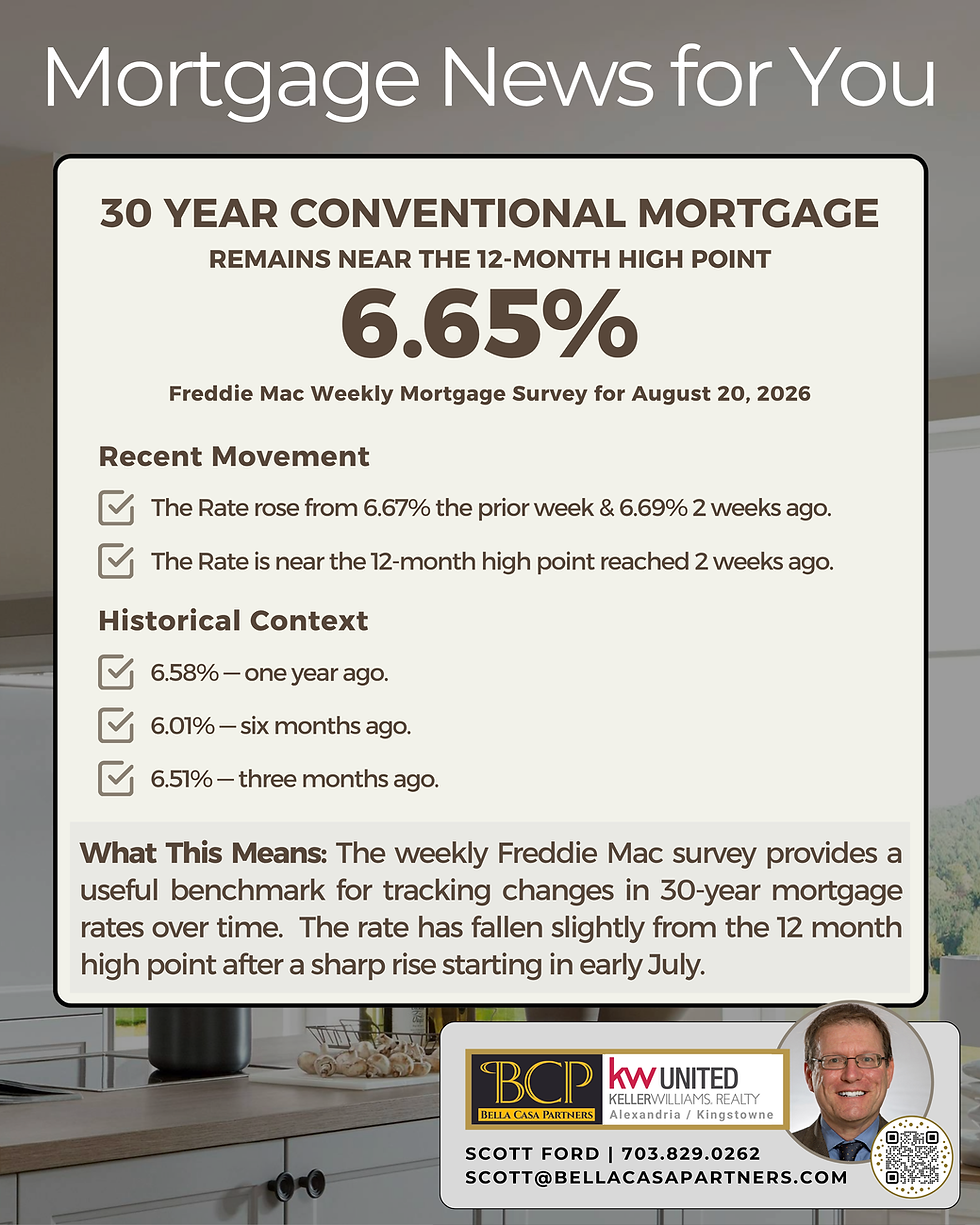
The latest Freddie Mac Primary Mortgage Market Survey reported an average 30-year fixed mortgage rate of 6.69% as of August 6.
For comparison:
One week earlier: 6.66%
Two weeks earlier: 6.58%
Three months earlier: 6.37%
Six months earlier: 6.11%
One year earlier: 6.63%
The August 6 reading represents the highest Freddie Mac 30-year mortgage rate during the past 12 months.
Should the Jobs Report and Mortgage-Rate Report Be Viewed Together?
The two reports provide different information.
The monthly Jobs Report measures employment and labor-market conditions.
Freddie Mac's weekly survey tracks average mortgage rates offered to qualifying borrowers under the survey's methodology (i.e., excellent credit, 20% down payment).
The fact that weaker employment data and a higher mortgage-rate reading were reported during the same week does not establish that one caused the other.
Viewed together, however, they provide useful context for two parts of the environment affecting housing decisions: broader economic conditions and the cost of mortgage financing.
What Does This Mean for Northern Virginia Buyers and Sellers?
National economic reports provide important context, but they do not determine how every local housing market will behave.
For Buyers, mortgage rates directly affect borrowing costs and purchasing power. Changes in employment conditions can also influence confidence about making a major financial commitment.
For Sellers, the more useful question is how Buyers are behaving within the specific competitive market for a House. Inventory levels, Buyer demand, competing Houses, pricing, presentation, and time on market can matter more to an individual sale than any single national economic report.
That is why broader economic information should be considered alongside micro-market analysis, rather than substituted for it.
What should Northern Virginia Sellers focus on when economic conditions are uncertain?
Sellers should focus on factors they can evaluate and control: current micro-market conditions, competitive inventory, pricing, presentation, and positioning. Broader economic data provide context, but successful listing strategy should be based on how Buyers are behaving within the House's actual competitive market.
Broader economic conditions and mortgage rates remain important parts of the housing environment. For an individual Northern Virginia Seller, however, the strategic question remains local: How are Buyers responding to Houses like mine, at my price point, in my micro-market right now?
That distinction—between national context and local Buyer behavior—is critical to making informed pricing and listing decisions.
Frequently Asked Questions
Why are monthly jobs numbers revised?
Monthly employment estimates are based on information available when the initial report is prepared. As the Bureau of Labor Statistics receives more complete employer data, previously reported employment estimates can be revised higher or lower.
What does the unemployment rate measure?
The unemployment rate measures the percentage of the labor force that is unemployed and actively looking for work. It is a different measure from the monthly payroll jobs number, which estimates changes in employment.
Does a weaker Jobs Report mean mortgage rates will fall?
Not necessarily. Employment data are among the economic indicators financial markets monitor, but mortgage rates are influenced by multiple factors. A single employment report therefore does not determine the direction of mortgage rates.
Why do mortgage rates matter to the housing market?
Mortgage rates affect the monthly financing cost of purchasing a House and therefore influence Buyer purchasing power and affordability. Their effect on an individual local market also depends on inventory, Buyer demand, pricing, and other micro-market conditions.


Comments