Vacant Home Risk in Northern Virginia: What Changes with Insurance When You Move Out Before Selling | Northern Virginia Real Estate Strategy

“What changes when I move out before selling?”
It’s a common step for many Sellers—especially when preparing a house for market or relocating before listing.
But once a home becomes vacant, several things change.
Some are obvious. Others are not.
One of the most important—and most often overlooked—is how insurance coverage and property risk can shift once a home is no longer occupied.
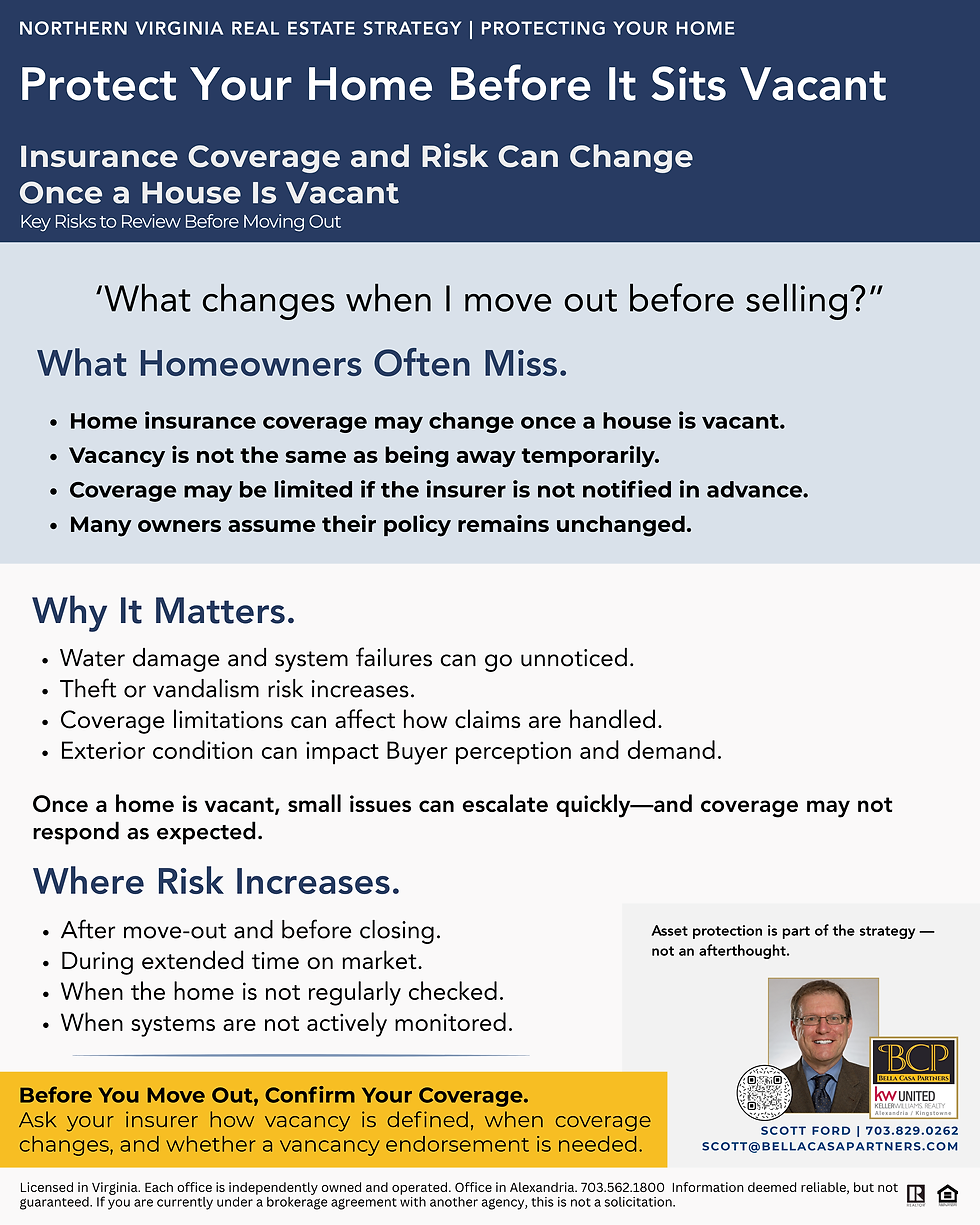
Vacancy Is Not the Same as Being Away.
Many homeowners assume their insurance coverage remains the same as long as they still own the property.
In practice, that is not always the case.
Insurance policies often distinguish between:
a home that is temporarily unoccupied.
and a home that is considered vacant.
That distinction matters.
Depending on the policy and duration:
certain risks may be limited.
coverage assumptions may change.
notification to the insurer may be required.
The key point is not that coverage automatically disappears—but that coverage may not respond the same way once a home is vacant.
How Insurance Risk Changes Once a Home Is Vacant.
The second shift is operational.
A vacant home no longer has a built-in monitoring system—the homeowner.
That changes how quickly issues are identified and addressed.
Common risk patterns include:
Water damage or system failures that go unnoticed.
Heating or cooling issues that create secondary damage.
Theft or vandalism, particularly in visibly vacant homes.
Exterior condition decline, including landscaping and upkeep.
Individually, these are manageable.
But vacancy allows small issues to persist longer—and escalation becomes the risk.
Why This Matters for Sellers.
For Sellers in Northern Virginia, vacancy typically occurs in a specific window:
after move-out.
before the home goes under contract.
or during extended time on market.
This period is not just about ownership—it directly affects:
property condition.
showing quality.
and Buyer perception.
A home that is not actively monitored can begin to:
show wear.
feel less maintained.
and compete less effectively against new listings.
In a market where Buyers are increasingly selective, that shift matters.
Where Gaps Commonly Occur.
Vacant property risk is rarely the result of a single issue.
It typically develops through a combination of small gaps:
Coverage is not reviewed when the home becomes vacant.
The insurer is not notified in advance.
The home is not regularly checked.
Systems are not actively monitored.
Maintenance becomes reactive instead of proactive.
None of these are unusual.
They are simply common assumptions carried into a different situation.
A Practical Step Before Moving Out.
This does not require a complex process—but it does require a deliberate step.
Before moving out, homeowners should confirm:
how their policy defines vacancy.
when coverage assumptions change.
whether any updates or endorsements are needed.
That conversation provides clarity on how coverage applies during the listing period.
Closing.
Vacancy is a transition point.
The home is no longer actively lived in—but it is not yet transferred to a new owner.
That transition creates a different risk profile—one that is often overlooked because ownership has not changed.
Understanding that shift, and taking a few practical steps before moving out, helps protect both the property and its position in the market.
Based on current Northern Virginia market conditions, preparation and timing decisions—including how a home is managed during vacancy—can influence both risk and outcome.
For additional insights, visit: BellaCasaPartners.com/marketnews
Who you work with matters.


Comments